When Was RAG Introduced and Why?
By Abdul Asim ·
The short answer
Retrieval-augmented generation is generally traced to a 2020 research paper by Patrick Lewis and colleagues at Facebook AI Research, titled Retrieval-Augmented Generation for Knowledge-Intensive NLP Tasks. Since then, RAG has grown from a research idea into one of the most common patterns for building generative AI applications. This guide explains why RAG was introduced, what problems it solves, and how it evolved from a simple pattern into the advanced pipelines used in production today.
Why RAG was introduced
Every large language model has a basic limit: it only knows what it was trained on, often called parameterized knowledge. Take GPT-4o in the summer of 2024 as an example. Its training data stops in October 2023, so it can answer questions about the 2020 pandemic but not about the 2024 European Football Championship. Asked about something it never saw, a model may simply make up a confident answer.
RAG was introduced to close that gap. The name describes the three steps. Retrieval searches for relevant data. Augmentation adds that data to the prompt as context. Generation passes the enriched prompt to the LLM to write the answer. Because the model is told to answer only from the supplied context, the retrieved data becomes the single source of truth and it becomes easy to check whether an answer is grounded.
The two problems RAG solves
RAG addresses two fundamental problems. The first is hallucination: without outside context, a chatbot asked about something outside its training data is likely to invent a plausible but false answer, which undermines trust in everything else it says.
The second is old or private information. Every model is trained on only a slice of the world's knowledge, for three reasons. You cannot train on private data you do not own or have rights to use. New data appears every second, so you would have to retrain constantly. And training or fine-tuning is far too expensive to repeat hourly or daily. RAG avoids all three by injecting the needed data into the prompt at question time instead of baking it into the model's weights.
Where RAG fits in the history of AI
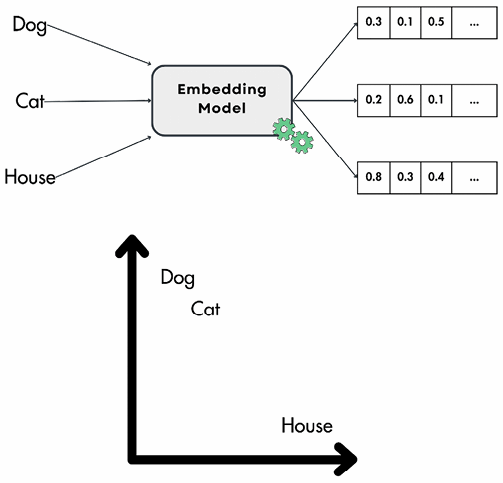
RAG sits at the center of the generative AI revolution. It depends on embeddings, which are numeric vectors that capture the meaning of text, images or audio so that similar items sit close together. Embeddings existed long before RAG. They evolved from early word methods such as Word2Vec and GloVe to encoder transformers such as BERT and RoBERTa, and were already used for recommender systems, clustering, classification and visualization.
What changed is that generative AI, built on RAG, made embeddings extremely popular for information retrieval: semantic search over text, code, images and audio, and long-term memory for agents. Vector databases such as Qdrant, Milvus, Weaviate, Pinecone, Chroma and pgvector grew up to store and search those embeddings at scale.
From vanilla RAG to advanced RAG
The simplest form of the technique is known as vanilla or naive RAG. It has three independent modules: an ingestion pipeline that fills the vector database on a schedule or continuously, a retrieval pipeline that searches it for entries related to the user's question, and a generation pipeline that combines a prompt template, the question and the retrieved context, then calls the LLM.
Naive RAG often retrieves the wrong or noisy context, so the field moved on to advanced RAG. Improvements fall into three stages. Before retrieval, you can improve chunking and rewrite, expand or route the query. During retrieval, you can use hybrid search, metadata filters and better embedding models. After retrieval, you can rerank results and compress the prompt. A robust evaluation module is also needed to measure retrieval and answer quality, using frameworks such as Ragas and ARES.
Key takeaways
RAG is usually dated to the 2020 Lewis et al. paper. It was introduced to stop hallucinations and to give models access to fresh and private data without costly retraining. It grew out of years of work on embeddings, became central to the generative AI wave, and has evolved from a simple three-module pipeline into advanced RAG systems with optimized retrieval and dedicated evaluation.
To go deeper, read our guides on what RAG is, how a RAG pipeline works, and how to build one.