What Is RAG Used For? Common Use Cases
By Abdul Asim ·
The common thread
RAG is used whenever a language model has to answer using information it was not trained on. Put simply: you need RAG when your application needs access to any type of external information. Because the model reads the relevant passages at question time, it can work with private, new or fast-changing data and reduce made-up answers.
Internal knowledge assistants
Companies keep policies, handbooks, wikis and meeting notes spread across many tools. A RAG assistant indexes these sources and lets employees ask questions in plain language, such as how many vacation days a new hire gets. The answer comes from the current policy document instead of the model's memory, and the source can be shown next to it.
Customer support
Support bots use RAG to answer from help-centre articles, product manuals and past tickets. Since the knowledge base is updated by re-running ingestion rather than retraining a model, a new feature or a changed refund policy can be live in the assistant quickly. Answers can include links to the articles used, which builds customer trust.
Document question answering
RAG lets people ask questions of long documents such as contracts, research papers, financial reports or case law. The system retrieves only the passages that matter and the model summarises, reformulates or extracts the answer. Lawyers using RAG over large databases of case law are one example of this kind of work.
Domain assistants that need fresh data
Some assistants are only useful when their data is current. A financial assistant is a typical example — it needs recent news, reports and prices — and so is a travel recommender, which needs a list of attractions, restaurants and activities. In both cases the model's training data is too old or too general, so the application retrieves the data it needs for each request.
Content generation grounded in your own material
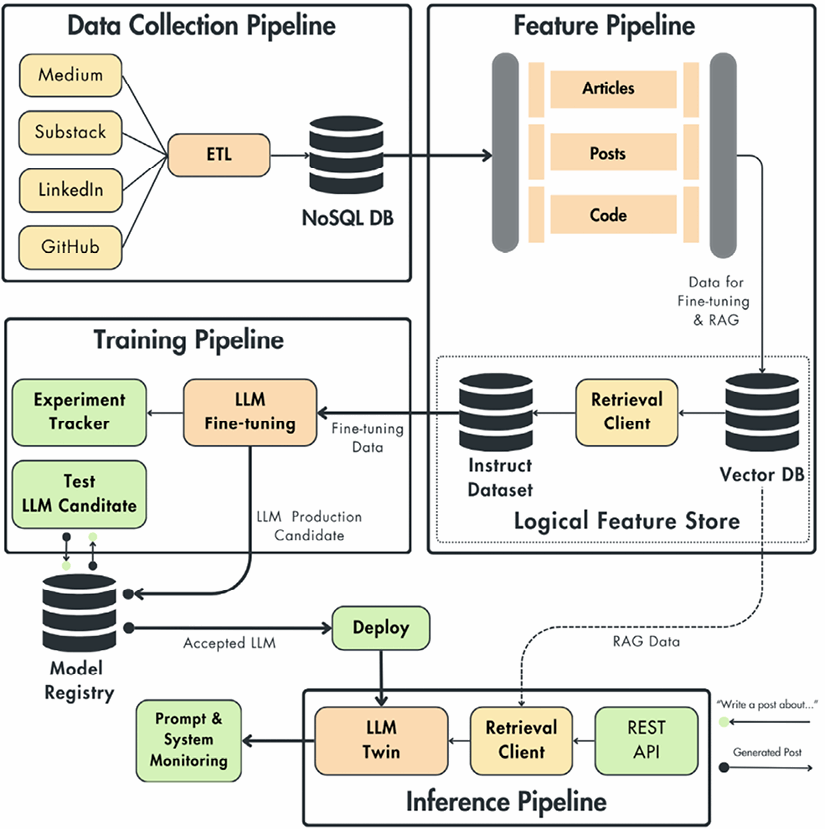
In an LLM Twin-style project, RAG supplies a person's own articles, posts and code repositories as context so that generated content reflects their ideas and style. The same pattern applies to drafting reports from internal data or writing product descriptions from a catalogue.
When RAG is not the right tool
If your task needs no outside information, such as translating a sentence you provide, retrieval only adds cost and delay. If you need to change how the model behaves rather than what it knows, fine-tuning is the better fit. To see how a RAG system is actually put together, continue to our guide on how a RAG pipeline works.