What an AI pipeline is (and why production systems use them)
By Abdul Asim ·
The short answer
A pipeline in AI is a series of automated steps that take raw material in at one end and hand a finished result out at the other. Each step does one job, and the output of one step becomes the input of the next. Think of an assembly line: nobody builds the whole car at one desk, and in the same way no AI system does everything in a single block of code.
The raw material is usually data. The finished result might be a trained model, a set of prepared records, or an answer to a user's question. The pipeline is what connects the two reliably, so that the same process can run again tomorrow, on new data, without anyone redoing the work by hand.
Why AI systems are built as pipelines
Splitting work into steps makes each step easier to build, test and fix. If answers suddenly get worse, you can check each stage and find the one that broke instead of searching one giant program. Steps can also run on different schedules and on different machines. Collecting data might run every night, while answering a question has to happen in a second.
Pipelines also make results repeatable. A model trained once by hand is a one-off experiment. A model trained by a pipeline can be retrained, compared with earlier versions and tracked. That repeatability is what separates a demo from a product.
The three pipelines most AI projects need
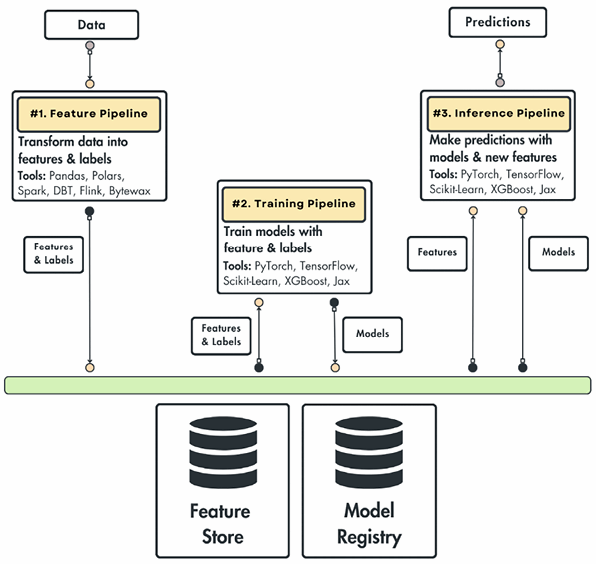
Production machine learning is often organised around three pipelines, an approach known as the feature, training and inference (FTI) architecture. The feature pipeline takes raw data, cleans it and turns it into something a model can use. The training pipeline uses that prepared data to train or fine-tune a model. The inference pipeline uses the finished model, plus fresh data, to produce answers for real users.
Each of the three has a single responsibility and talks to the others through a clear contract, such as a stored dataset or a registered model. Because they are independent, you can improve one without breaking the rest.
Common types of AI pipelines
A data pipeline collects, cleans and moves data, often in scheduled batches. A training pipeline turns data into a model. An inference pipeline serves predictions. A retrieval-augmented generation pipeline, usually called a RAG pipeline, is a special case that fetches relevant documents and gives them to a language model so it can answer from them. Our guide to RAG pipelines covers that case in detail.
Whatever the type, the idea is the same: break a hard job into small, ordered, automated steps.
Batch and streaming pipelines
Pipelines run in two broad styles. A batch pipeline gathers data and processes it in chunks at set intervals, such as hourly or daily. It is efficient and simpler to run. A streaming pipeline processes each piece of data as it arrives, which gives fresher results but takes more infrastructure and effort. Batch is often preferred for RAG data pipelines when the data does not need to be second-fresh and batch is far easier to maintain.
If you are starting out, begin with batch. Move to streaming only when your use case truly needs real-time freshness.
Key takeaways
An AI pipeline is an ordered chain of automated steps from raw data to a useful result. It exists to make AI work repeatable, testable and easy to maintain. Once you are comfortable with that idea, the next step is to see how it applies to language models, starting with what retrieval-augmented generation is.